
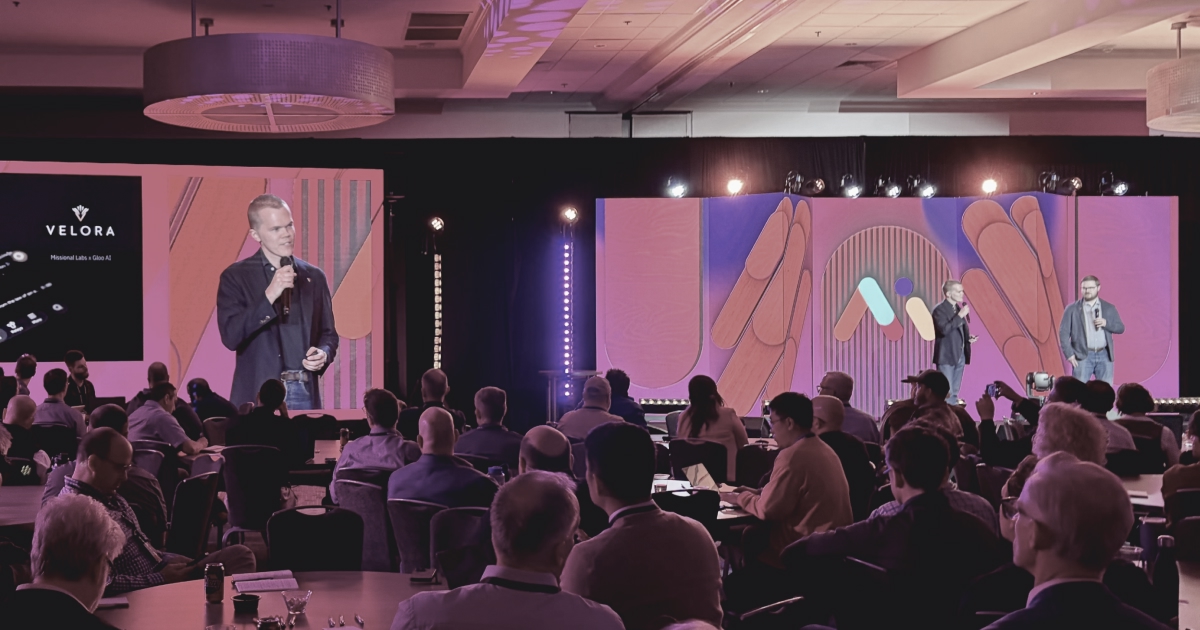
Two weeks ago, my brother Colin and I attended Missional AI 2026 in Silicon Valley. We had the opportunity to present Velora, our smart Bible app that helps Christians engage more deeply with the preached Word in their local church. We had a great time meeting other believers who are building and using AI tech for redemptive purposes, and we left with a clearer conviction about what faith-driven technology can and should be.
What follows are a few reflections from the week—on how Christian technologists are shaping AI and what it means for how we're building Velora.
Much of the Christian conversation about AI operates in a defensive posture. The questions tend to be: How do we prevent harm? How do we set guardrails around what's already been built by others?
The leadership at Missional AI named this pattern plainly in their framing of the summit. Responsible AI is reactive. Redemptive AI is proactive. Responsible AI assumes AI is happening to the church. Redemptive AI recognizes that Christians have real agency to shape what gets built—as designers, researchers, engineers, and theologians working together on the ground floor.[1]
This is a meaningful reframing, and it doesn't ignore the real dangers. It simply insists that the church has more to offer than a cautious critique of other people's tools. We can also build.
That conviction was threaded through the whole week. Bible translators talked about compressing translation timelines from decades to years. Researchers presented frameworks for evaluating how a given AI model or application aligns with biblical values and serves human flourishing. The mood at the conference was energetic and hopeful without being naïve—aware of the stakes, and unwilling to cede the field.
One thing we noticed was a great sense of unity around certain core principles for how Christian builders should approach AI, across the various denominational backgrounds represented.
Cameron Pak, founder of the faith.tools platform, is one of the builders we had the privilege of meeting at the summit. He has proposed a helpful, unofficial rulebook for Christians building AI apps:[2]
AI output must be biblically accurate.
AI output must not fabricate or misrepresent Scripture.
AI output must clearly identify as AI, not human.
AI output must not replace human relationships or spiritual practices.
AI output must balance grace and truth, while not neglecting one of the two.
Missional AI has since published its own Christian Framework for AI Ethics that lands in a very similar place. Across traditions, two central convictions have emerged:
AI should not replace human relationships. Pastor Jeremy Bell has described unhealthy AI attachment as "creating a dependence on the machine that is continuing to push people away from reality and away from real, biblical community."[3] The National Association of Evangelicals argues for an "AI-enhanced, not AI-dependent" posture, warning that "AI can analyze data, but it cannot shepherd hearts."[4] Scripture is unambiguous here. "Iron sharpens iron, and one man sharpens another" (Proverbs 27:17). "Confess your sins to one another and pray for one another, that you may be healed" (James 5:16). Discipleship has always required a mutual relationship between people who actually need each other.
AI should not become a generative source of spiritual wisdom. The risk isn’t merely in AI’s potential to generate inaccurate theology, but also in what happens spiritually when a believer begins looking to generated output as a guide. The Reformers rightly reminded us that Scripture, read and preached in the church’s public worship, is the ordinary means by which God builds faith in his people. Biblical wisdom is cultivated through local church communities devoted to “the apostles’ teaching and to fellowship, to the breaking of bread and to prayer” (Acts 2:42). A chatbot can tell you what your pastor has taught about wisdom. Only the Spirit working through the Word can make you a person of wisdom.
The most encouraging thing about the summit was seeing how many Christians have internalized these two principles and are already applying them in actual tech products for the church.
A recurring theme throughout the week was how isolating this work can feel. Many of the people we met were either small startup founders like ourselves, the only AI person in their ministry organization, or one of just a few Christians on a larger secular team.
Three days in Silicon Valley with more than 600 like-minded Christian technologists and ministry leaders was a perfect way to overcome that sense of isolation.
We’re particularly grateful to Tyler Prieb and the Missional Labs cohort. The encouragement, sharpening, and wisdom we've received from that community over the last several months has been invaluable. Missional Labs is the reason we came to the summit with a clearer articulation of what Velora is and is not, and it’s the reason we left having made many rich new friendships.
There is something deeply encouraging about sitting across the table from other founders who are asking the same questions we are. How do we create a sense of reverence in our product design? How do we resist the pull to let AI do the spiritual work that should be left to biblically-ordained spiritual leaders? How do we measure whether our tool is actually serving someone's walk with Christ, beyond mere engagement metrics?
Despite the many sharp minds and seasoned entrepreneurs present, the atmosphere at Missional AI was one of humility. No one in the room claimed to have it all figured out. Everyone was eager to learn from one another—even at times stopping to pray with one another.
Missional AI strengthened our core conviction about what Velora should be.
Rather than replace your pastor with a chatbot, we want to leverage AI for a more redemptive purpose: to help you internalize more deeply the biblical preaching you hear every week. We want you to center your whole week around your own pastor’s preaching.
In alignment with Missional AI's "redemptive" design principle, we’re considering not only what harm we might prevent, but what good we might actively achieve. And we believe there is an opportunity for meaningful good here. Research suggests that people retain only about 5% of sermon content shortly after hearing it. The preached Word has lost none of its power, but our media ecosystem of high-volume, short-form content has shaped our attention and focus in ways no prior generation has experienced. This is the problem we aim to address with Velora.
Decisions being made at frontier AI companies right now will shape human experience for decades. If Christians are going to have a meaningful voice in that conversation, it will be because we showed up—not as critics from the sidelines, but as builders at the center of the innovation.
Missional AI is a call not only to Christian tech builders, but also to Christian tech users. We need thoughtful early adopters who can shape these emerging technologies from a biblical worldview. In this way, the Missional AI community has made us even more grateful for our Velora community. We’re back at work, humbled to be part of this global movement and inspired to launch Velora with you.
Missional AI — The Moment of Inflection
faith.tools — Unofficial Rules for AI Apps for Christians
ReligionUnplugged — Churches Confront the Spiritual and Emotional Risks of Chatbot Attachment
Velora is a smart Bible app that helps you follow along with your pastor's preaching and engage more deeply with the Word at your local church. If that sounds like something you've been looking for, we'd love to have you join our waitlist.